
Coryell County Criminal Court Cases
Coryell County criminal court cases split by the level of the filed charge. The 52nd and 440th District Courts hear felony matters. The County Court at Law handles Class A and Class B misdemeanors as well as NISI matters. A NISI docket concerns a conditional judgment tied to bond forfeiture. Justice Courts 1 through 4 and municipal courts keep fine-only criminal matters within their own jurisdiction. Those lower-court records do not automatically become district-court files.
The Coryell County District Clerk is custodian for both district courts. Its counter is at 620 E Main Street in Gatesville. Call 254-865-5911, choose 1 for the District Clerk, then 2 for criminal. The office lists weekday hours from 8 a.m. to 5 p.m., with a noon-to-1 p.m. closure. The clerk can route a cause search, identify available copies, and explain certification. For a misdemeanor, use the County Court at Law and county-clerk route instead.
Coryell Criminal Courts by Charge
A booking label is only the first description of an alleged offense. Prosecutors may reject, amend, or replace it before filing. Searchers should therefore use the filed classification to choose a Coryell County court, then confirm the cause number with that court's clerk.
| Court | Criminal role | Official route |
|---|---|---|
| 52nd District Court | Felony district matters | District Clerk at the courthouse |
| 440th District Court | Felony and labeled TDCJ dockets | Leon Street Annex |
| County Court at Law | Class A/B misdemeanors and NISI | County court and clerk |
| Justice or municipal court | Fine-only and city matters | The issuing court's clerk |
The 52nd District Court page publishes dated criminal dockets rather than a party-name index.
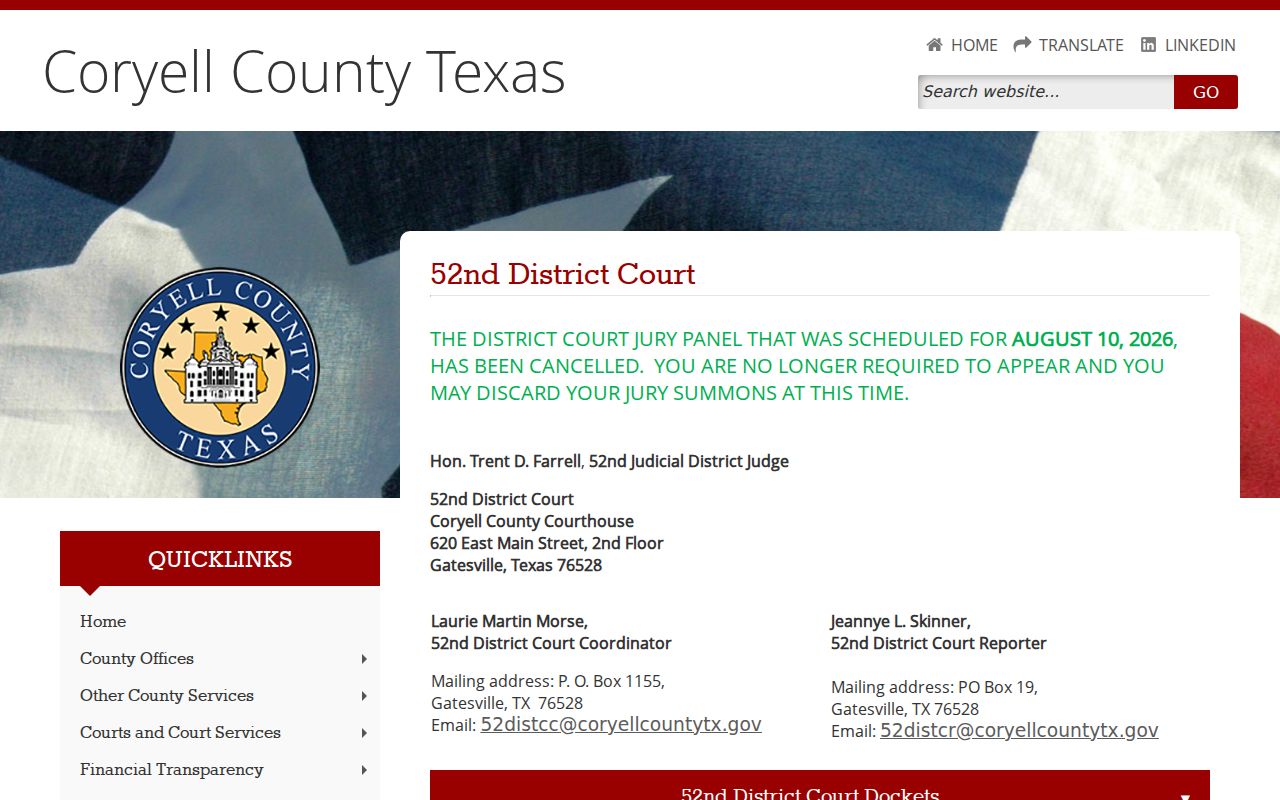
The image shows the court's official docket route, which is useful when a hearing date or docket label is already known.
A district docket and a County Court at Law docket can use similar terms without covering the same class of offense. Begin with the court printed on the record. If that detail is missing, ask the District Clerk whether the name belongs in a felony index and ask the County Court at Law about the misdemeanor route. City citations and Justice Court charges require a separate clerk call. This court-level check keeps a search from stopping at the wrong file room.
The District Attorney handles felony prosecution in the 52nd Judicial District, while the County Attorney prosecutes misdemeanors. Those offices may create or hold prosecutor records, but the filed court record remains with the clerk. Ask the prosecutor only for material that office maintains. For the authoritative charge and outcome, return to the court cause and its signed orders. This distinction is especially useful when an arrest report uses one charge phrase and the filed information or indictment uses another.
Searching Coryell County Case Records
Coryell County has no comprehensive public party-name or cause-number portal. Its court pages organize dated PDF dockets by court and year. A browser can search text within a selected PDF, but that document is a schedule, not the full case index. Use the clerk when the hearing date is unknown, the online list is incomplete, or the actual pleadings and judgment are needed.
- Classify the filed charge as felony, Class A/B misdemeanor, or fine-only so the search begins with the right court.
- Choose the 52nd, 440th, or County Court at Law page and open the year that could contain the setting.
- Select a dated criminal docket, then use the browser's PDF text search for a known name or cause number.
- Read the setting and offense fields as schedule data. Do not treat the PDF as proof of final disposition.
- Ask the proper clerk for the index, docket sheet, charging instrument, orders, judgment, sentence, and any certified copies needed.
The county docket interface has only browse controls. It does not supply the search fields found in a modern case database.
| Field Label | Type | Required | Notes |
|---|---|---|---|
| Court page | Page selection | Yes | Choose 52nd, 440th, or County Court at Law |
| Year accordion | Browse/filter | Yes | Available years differ by court |
| Docket date/title | PDF link | Yes | Labels may include criminal, NISI, jury, dismissal, or TDCJ |
| PDF viewer | Browser control | No | Free view or download; no login |
| Name or cause number | Not provided | No | Only browser text search within an opened PDF may help |
A useful clerk request gives enough detail to distinguish people with similar names. Supply a middle name, estimated filing year, cause number, charge, and known hearing date when those facts are already available. Do not send extra sensitive identifiers unless the clerk says they are needed through an approved channel. Ask whether the result is an index entry, a plain copy, or a certified record. Each product answers a different need, and the research did not confirm a current countywide online copy service.
Older records can require a different route. The Texas State Library lists Coryell County court minutes from 1876 through 1914 on microfilm. Those materials serve historical and genealogy research, not current case status. Begin with the library inventory when the event predates the modern clerk system, then cite the volume and date when asking for help. A historical minute entry should not be mixed with a modern criminal docket or used to infer present custody.
Coryell Dockets Are Schedules
An official Coryell County Court at Law docket may show the court, setting date, time, cause number, the State of Texas case style, offense text, bond notation, attorney, and hearing type. One observed cause-number format began with a two-digit year. These details can confirm that a matter was set, but they do not supply the whole record.
The schedule did not show a full event log, filing date, overall status, statute citation, attached pleadings, financial ledger, judgment, or sentence. A listed announcement setting is not a disposition. Ask the clerk for the register or docket sheet and the signed final order before drawing a conclusion. The County Court at Law page is the official browse point for misdemeanor dockets.
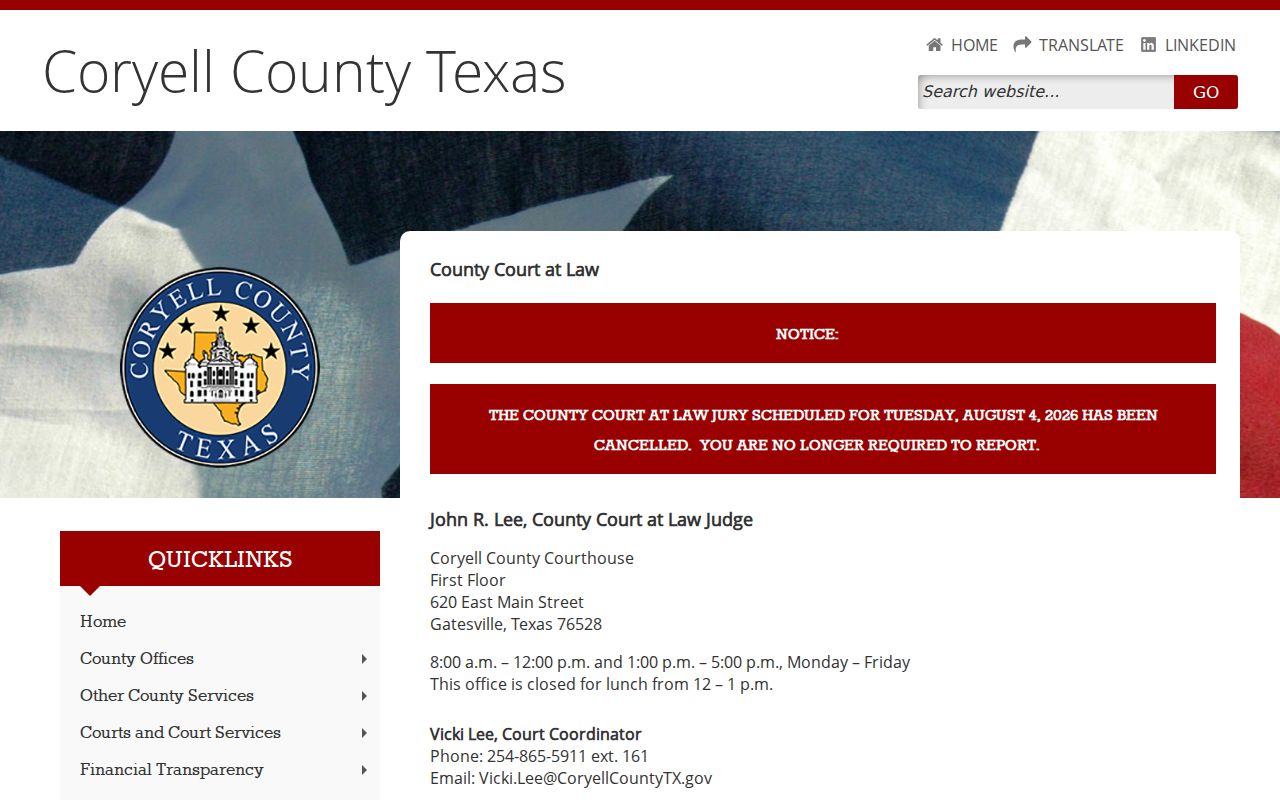
That official page illustrates why the online docket works best as a lead to the clerk-held case file.
Docket labels also deserve care. “Criminal” identifies the division, while “jury,” “dismissal,” or “TDCJ” may describe the type of setting or list. NISI refers to a bond-forfeiture process, not a new offense finding. Read the heading and the row together. If an old PDF is the only online trace, give its date and cause number to the clerk and ask for the current status plus the final signed order.
Note: A setting on a dated Coryell docket does not establish the final result of the criminal case.
Inside a Coryell County Case File
The case file follows the filed prosecution, not merely the arrest. It may show how the initial allegation changed, which plea was entered, what motions and orders were filed, and how each count ended. Not every paper is available online, and protected information can be redacted.
| Case Number & Court | Identifies the specific cause and the court with custody of the file. |
|---|---|
| Charging Document | A complaint, information, or indictment states the charge that moved forward. |
| Docket Entries | Chronological entries can record filings, settings, pleas, motions, and orders. |
| Hearing Dates | Scheduled and held proceedings may include arraignment, announcement, pretrial, plea, or trial. |
| Disposition & Judgment | The outcome may be conviction, acquittal, dismissal, deferred adjudication, or another count-level result. |
| Sentence & Conditions | A signed judgment can state confinement, community supervision, fines, costs, and court conditions. |
A disposition must be read count by count. One charge may be dismissed while another ends in a plea or judgment. Coryell County criminal case records should be checked against the signed order when a docket entry is brief or unclear.
Common terms can mark very different results. An indictment is a grand jury's formal felony accusation. An information is a prosecutor-filed charge often used for misdemeanors. Deferred adjudication is supervision without an initial adjudication of guilt, yet Texas DPS may publish it unless later protected. Acquittal means a not-guilty outcome, while dismissal ends a charge without conviction on that count. The exact wording and signed document matter more than a broad case-status label.
Coryell District Clerk Criminal Requests
When a PDF does not answer the question, call the criminal routing line with the person's name, an estimated filing year, the court if known, and a cause number if one appears elsewhere. Be precise about the item sought. An index search, charging instrument, docket sheet, judgment, sentence, and certified copy are different clerk products.
Coryell County District Clerk
620 E Main Street
Gatesville, TX 76528
254-865-5911, dial 1 then 2
Monday-Friday, 8 a.m.-noon and 1-5 p.m.
The official District Clerk contact page shows the counter, hours, mailing route, and criminal phone prompts.
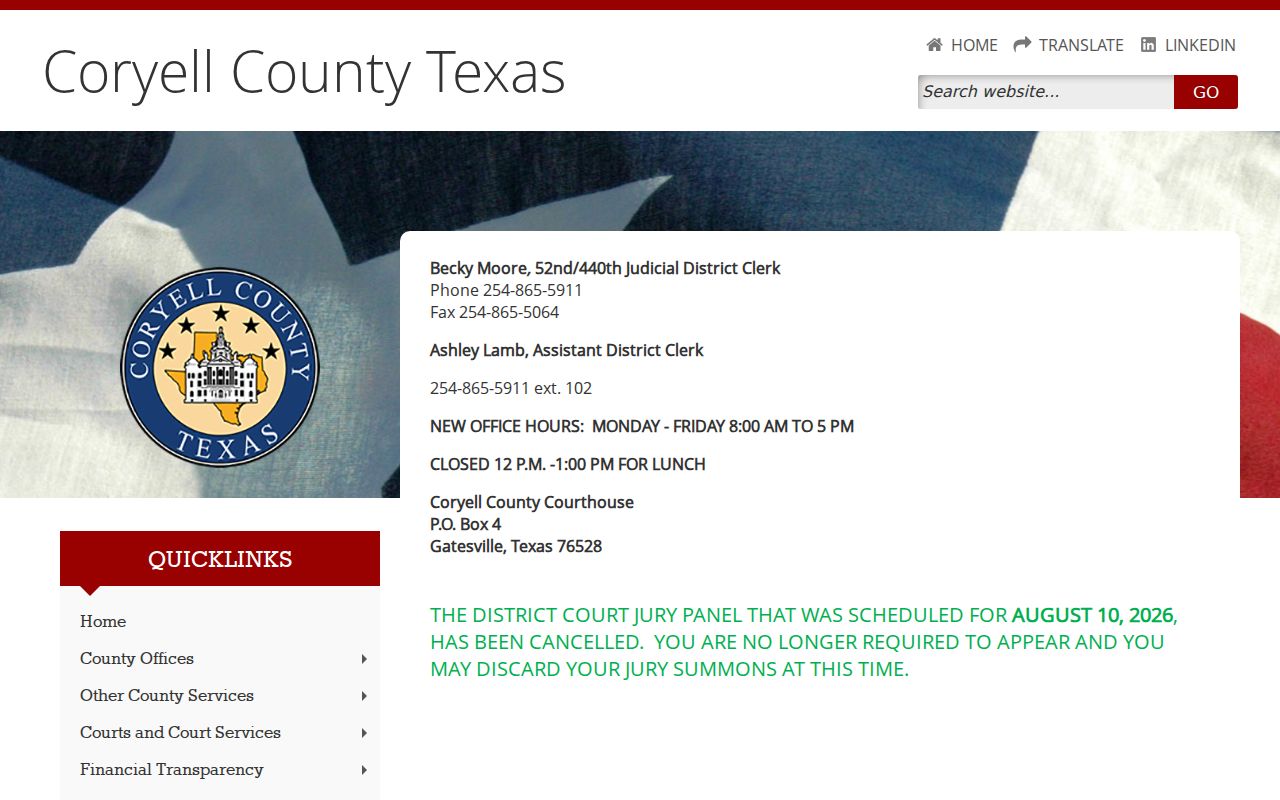
The displayed routing matters because the same county number serves several offices. A 2019 fee PDF listed a $5 name search and $1 per page, including certified copies, but that schedule is old. Verify every current fee before ordering.
Before paying, ask the clerk to confirm the current search, copy, and certification charges and the accepted payment method. The research found no dependable current fee schedule and no published turnaround for a Coryell County criminal file request. A visitor should also verify counter access before travel because the county does not publish complete parking, screening, phone, recording, or public-counter room rules. The courthouse page confirms an elevator and accessible entrance, but not those visit details.
How a Criminal Case Moves
An arrest and booking may start the paper trail, but the court file begins with the charge that is actually filed. The defendant is arraigned, pretrial issues and motions are addressed, and the case moves toward a negotiated plea or trial. The court then records a disposition for each charge. If the result permits punishment, a judgment and sentence follow. Coryell County publishes settings, not a promised timetable for each stage.
Case flow: Charges Filed › Arraignment › Pretrial › Plea or Trial › Disposition › Sentencing
These stages explain why a booking charge and a later judgment can differ without either record being misfiled. The arrest entry captures one moment. The Coryell County court file records the legal decisions made afterward.
A plea bargain is a proposed negotiated result between prosecution and defense, subject to court action. A disposition is the outcome entered for a charge. Sentences may run concurrently, at the same time, or consecutively, one after another. Community supervision is Texas's term for probation. These terms should be confirmed in the judgment rather than inferred from a short setting note or an older booking charge.
Coryell Felony Docket Split
The two felony courts do not share one public docket screen. The 52nd District Court works from the historic courthouse, while the 440th District Court operates at 417 E Leon Street. The 440th page lists criminal dockets and dockets labeled TDCJ. Select the court named on the cause before browsing by year.
The 440th District Court page provides annex contacts and its docket library.
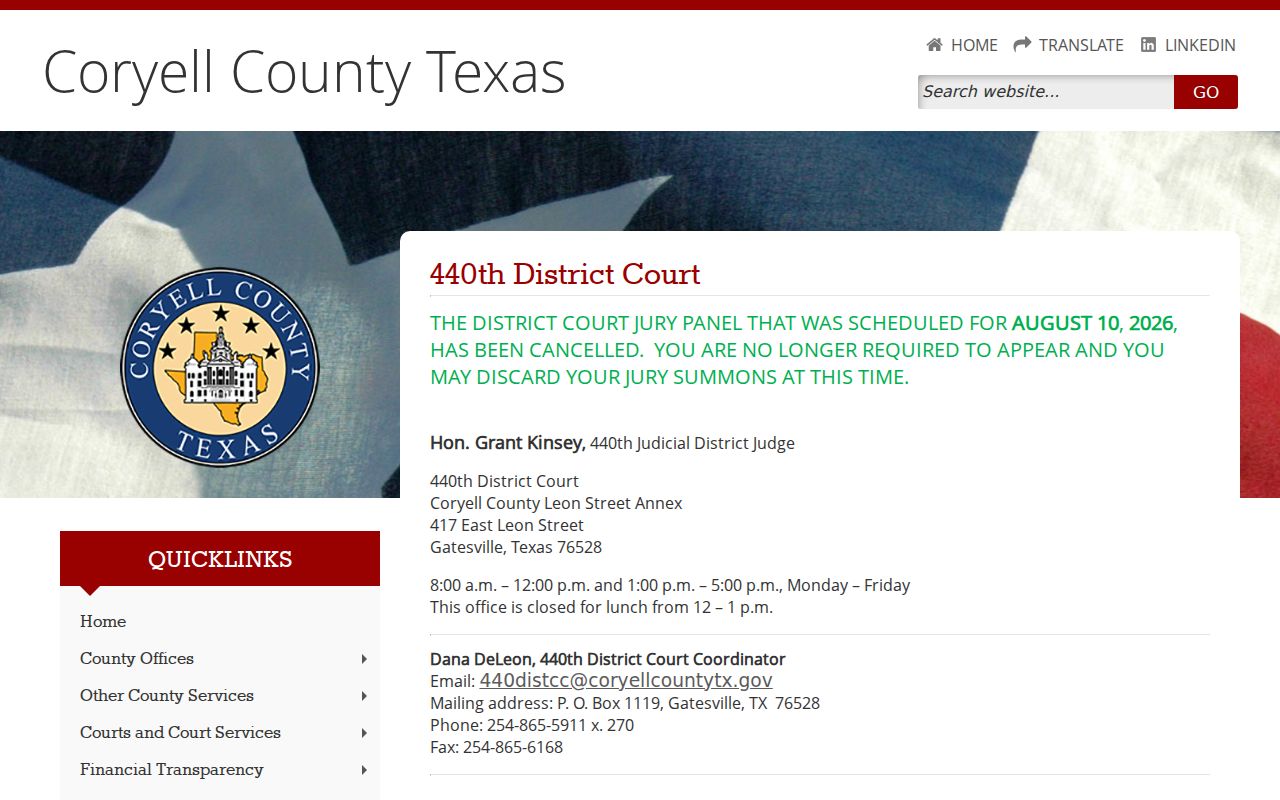
The annex view helps prevent a needless trip to the wrong Coryell County building. Its listed office hours are 8 a.m. to noon and 1 to 5 p.m. on weekdays, with phone extension 270.
The 52nd court sits on the courthouse's second floor, while the County Court at Law is on the first. Physical proximity does not merge their records. The District Clerk keeps the district files, and misdemeanor material follows the County Court at Law and county-clerk structure. When a name appears on more than one docket, use each cause number separately. Combining rows from distinct causes can blur counts, outcomes, and sentences that the courts keep apart.
re:SearchTX Coryell Criminal Coverage
re:SearchTX is Texas's statewide electronic-court-record platform, but public criminal coverage and document access vary. It should not replace the Coryell County clerk or the local docket pages. Registration may be required, and document charges can depend on access and court participation.
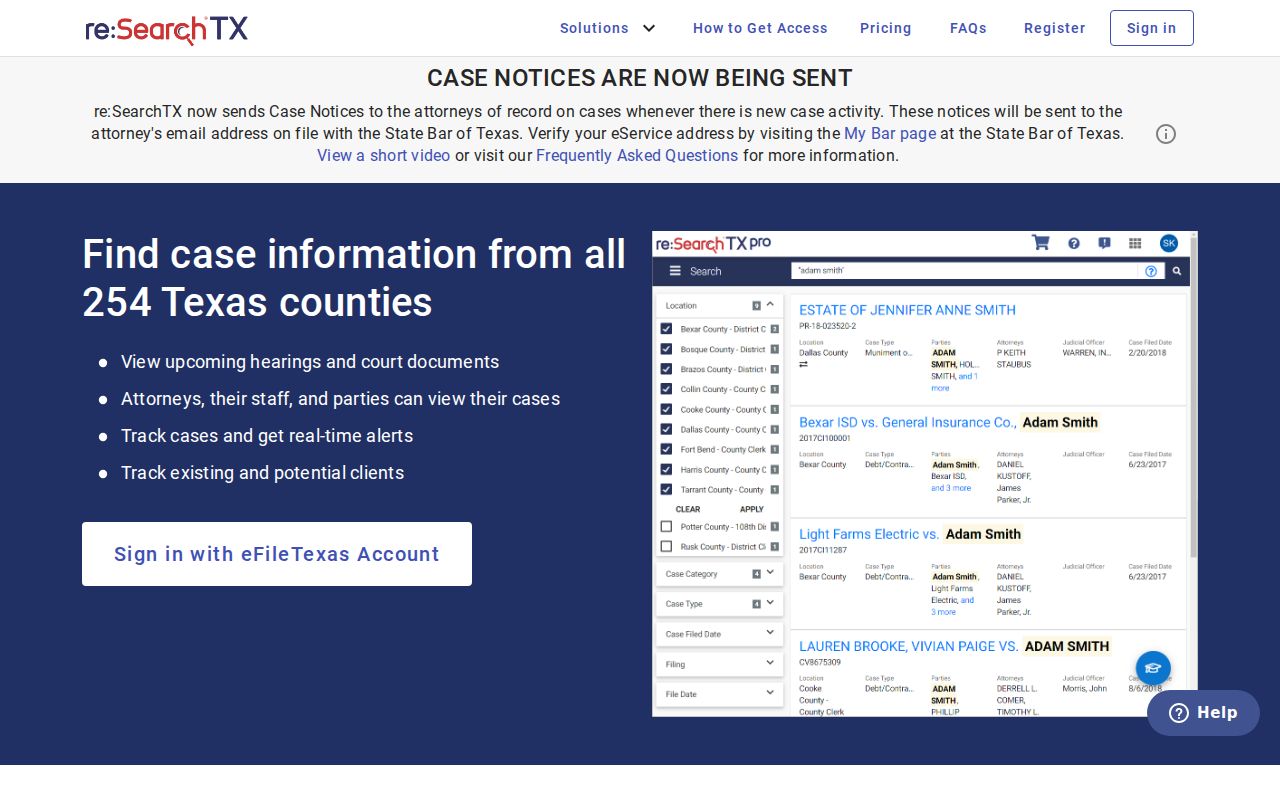
The portal image shows a statewide entry point, while Coryell County's own court pages remain the dependable route for local court identity and dated settings.
If re:SearchTX returns nothing, do not treat that as proof that no case exists. Confirm the court level, then contact the clerk. Fine-only city and justice-court matters may remain with the issuing court rather than the county district system.
The statewide portal is most useful as a second check when its coverage includes the court and document type sought. The local page can establish that a dated Coryell County setting was published. The clerk can confirm the index and provide the filed record. re:SearchTX may add electronic access where available. Using all three in that order avoids treating a statewide coverage gap as a local no-record result.
Case Record Access & Restrictions
Texas access rules distinguish ordinary agency information, judicial records, and the records filed in a court case. The Texas Judicial Branch open-records policy explains those separate tracks. For a Coryell County criminal case, the clerk of the court is generally the case-record custodian. A Texas Public Information Act request to an unrelated agency is not a substitute for asking that clerk.
Public files can still omit or redact juvenile material, victim and minor identifiers, Social Security and driver-license data, protected addresses, sealed or expunged records, and information covered by an order of nondisclosure. Full Texas DPS criminal-history data is also confidential except where release is authorized. The public DPS product is a narrower conviction and deferred-adjudication view, not a copy of the court file.
A missing online docket can reflect the wrong court, a date outside the visible library, limited electronic coverage, or lawful restriction. It is not a sound basis for declaring the case nonexistent. For the broader arrest-to-court distinction, consult the Coryell County arrest lookup and then verify the filed outcome here.
Expunction and nondisclosure also have different effects. Expunction under Texas Code of Criminal Procedure Chapter 55A can direct covered records to be destroyed or returned when statutory conditions are met. An order of nondisclosure restricts public dissemination but preserves access authorized by law. Neither protection should be assumed from a dismissal alone. If a Coryell County case is absent after an order, confirm the exact cause and arrest covered by that order with the clerk and originating agencies.
If a public case file contains an apparent mistake, preserve the cause number and obtain the clerk's current copy before seeking a change. A missing disposition in Texas DPS may reflect reporting delay rather than an error in the Coryell County judgment. Compare the filed court outcome with the statewide entry, then use the correction channel of the system that is wrong. The court clerk cannot rewrite a DPS display, and DPS cannot supply a pleading that belongs in the local case file.
Federal criminal cases are another separate layer. Coryell County federal trial matters fall within the Western District of Texas, Waco Division, and federal dockets use PACER rather than a Coryell clerk. A county search should therefore stop only after the likely jurisdiction is clear. State district, county, municipal, justice, and federal courts maintain different files. Matching the court name, cause number, and charge level is safer than relying on a name alone, especially when common names produce more than one possible record.